

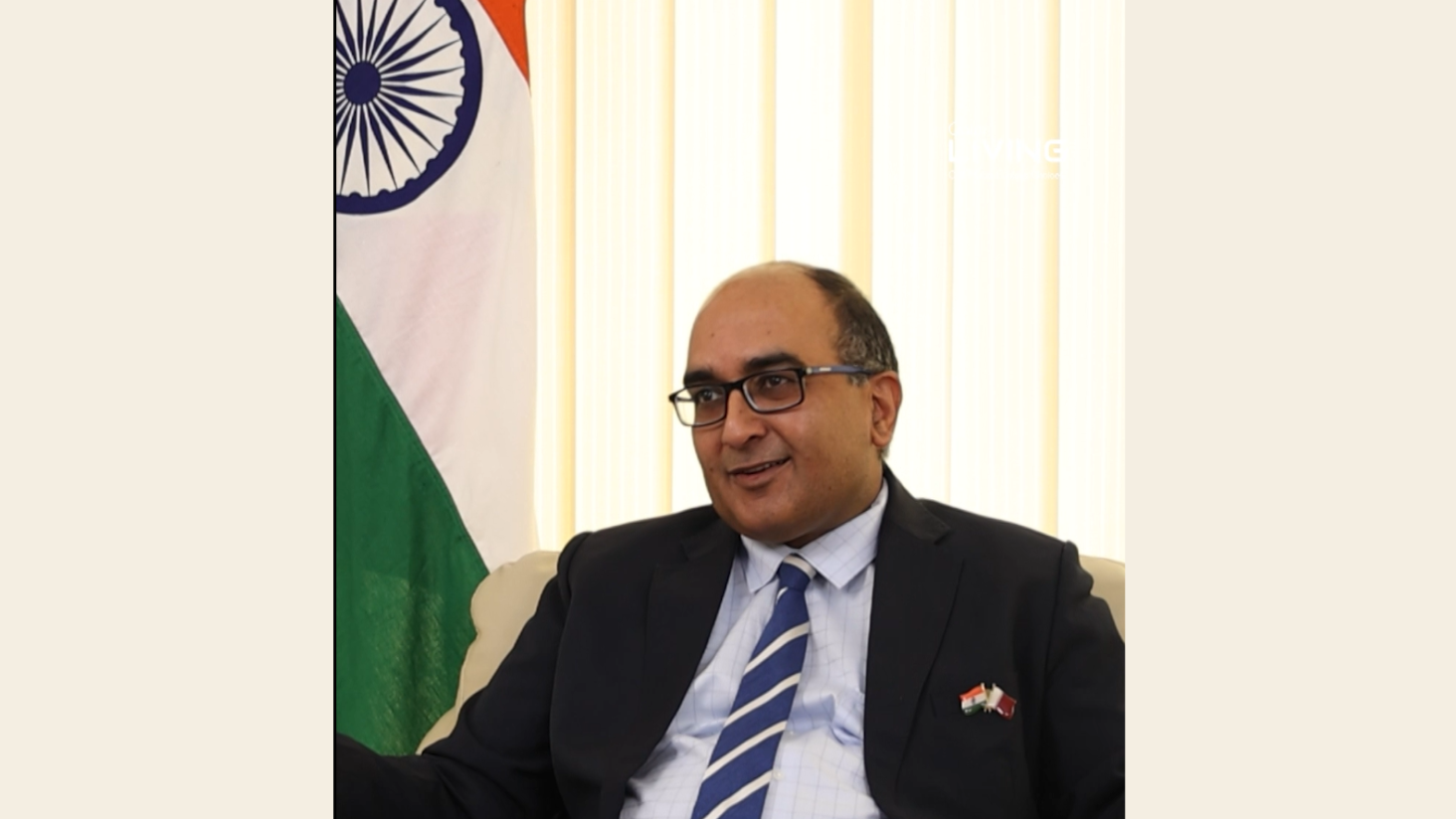
By Dipti Nair
His Excellency Vipul, Ambassador of India to the State of Qatar, has had a distinguished diplomatic career spanning nearly three decades, with postings across several regions. Since his arrival in Doha in 2023, he has worked to deepen India–Qatar ties across trade, energy, culture and people-to-people connections. In this exclusive one-on-one interview, HE Vipul reflects on his diplomatic journey, the state of bilateral relations, and his priorities during his tenure.
You’ve had an impressive diplomatic journey across multiple regions before arriving in Doha. What were your expectations of Qatar before your arrival in 2023, and how have your views evolved since taking office?
I have served in the Indian Foreign Service for about 27 years, with postings in several countries and a range of responsibilities. It was a singular honor when the government appointed me Ambassador to Qatar. I knew a little about Qatar before arriving — its friendly people and our historic ties — and my objective was to contribute to advancing that relationship. I am very pleased that over the past two years we have achieved several important milestones. For an ambassador, there is nothing greater than high-level visits by a prime minister or a head of state; such interactions reflect the depth of the bilateral relationship, and they have helped strengthen ties between our countries.
You served as Consul General in Dubai and later as Joint Secretary (Gulf). How have these experiences prepared you for your current role in Doha?
I served as Consul General in Dubai from 2017 to 2020, which provided valuable regional experience and context. From 2020 to 2023 I served as Joint Secretary (Gulf) in the Ministry of External Affairs, responsible for relations with eight countries, including Qatar (the GCC countries plus Yemen). That role gave me a solid grounding in the history and dynamics of the region and in the various aspects of our bilateral relationships, which I have been able to build on as Ambassador.
India and Qatar share strong historical and cultural ties. How would you describe the current state of bilateral relations, especially in trade, energy cooperation, and cultural exchange?
Since my arrival we have seen a series of high-level interactions — visits by leaders and ministers — that have advanced our strategic partnership. These engagements have deepened cooperation across political dialogue, investment, energy, culture, technology and people-to-people ties. Across the board, India–Qatar relations are excellent, and both leaderships are committed to elevating the partnership further by building on our strong historic foundation.
Having studied at IIT Delhi and ISB Hyderabad, you have a strong technical and business background. How do you leverage this experience when promoting trade and technology partnerships?
I studied mechanical engineering and later completed an MBA, which provides both a technical and a business perspective. Although my engineering degree was many years ago and technology has evolved dramatically, that foundation helps me understand technology and trade issues more tangibly — for example, developments in blockchain and biotechnology. My education and professional network also help in promoting collaborations between Indian and Qatari institutions, including higher-education and research partnerships, which I regard as a priority.
The Indian expatriate community is one of the largest in Qatar. How does the Embassy ensure efficient and timely consular services for such a large population?
The Indian community here is sizeable, and providing consular services is a major focus. We have a substantial team handling passports, documentation and other consular services, supported by a robust system of community outreach. There are many Indian community organizations that keep in touch with the wider community, and these organizations play an important role because embassy officials cannot reach every individual directly. We also use modern communication channels — WhatsApp groups, Twitter, email and other platforms — to stay connected and provide services efficiently.
Are there any new initiatives, cultural programs, or economic collaborations done or being planned during your tenure to further enhance India-Qatar relations?
We continually work to increase trade and investment, promote cultural exchanges, and strengthen institutional cooperation between governments and businesses. We host trade delegations and pursue institutional arrangements that facilitate investment flows; during His Highness’s visit to India several steps were discussed to encourage greater Qatari investment into India. Both sides have set an ambition to significantly increase bilateral trade in the coming years. Several memoranda of understanding were signed during high-level visits, including on sports and youth affairs and on archives. We also plan more cultural delegations in music, dance, visual arts and other areas to deepen people-to-people ties.
India is known for its rich traditions and diverse festivals. Is there a particular Indian festival or tradition you would like to see celebrated on a larger scale in Qatar?
With such a large Indian community, we celebrate many festivals across communities. There is particularly strong participation for Onam from the Kerala community, and many community organizations hold vibrant events during Eid. At the Embassy we celebrate Raksha Bandhan and Diwali, among others. I would like to see these festivals continue to be celebrated on a large scale with broad community participation.
What is one aspect of Qatari life or culture that you find most fascinating or unique compared to other countries where you’ve served?
What fascinates me is how Qatari society balances modernity and tradition — a commitment to development while preserving family values. That combination resonates with India and creates a natural connection between our peoples.
With Qatar being a hub for international events and India’s growing global presence, do you foresee more collaboration in areas like sports, tourism, or education?
During His Highness’s visit we signed an MOU on youth affairs and sports, which is important given the large Indian presence here. We have already seen Indian athletes and teams participate in events held in Qatar — in football, chess, athletics and other sports. Qatar’s world-class sports infrastructure offers opportunities for joint programmes, exchanges and training for young athletes. I expect collaboration to grow not only in sports, but also in tourism and education, where there is significant potential.
If you had to introduce one Indian dish to someone in Qatar who’s never tried Indian food, which would it be?
I find it hard to imagine someone who has never tried Indian food. If someone has not yet tasted it, I would encourage them to try the Biriyani, a classic Indian dish that captures our flavors and regional variety — something that gives a good introduction to Indian cuisine.
A message to Indian expatriates for Indian Independence Day 2025.
On Independence Day we must remember the sacrifices of those who devoted their lives to India’s independence in 1947, and honor all those who have contributed to building India into the nation it is today. We should remember the sacrifices of our soldiers and all citizens who work for the country. As the Prime Minister has called for, we should use this day to reflect on how each of us can contribute toward India’s progress and towards the vision for Viksit Bharat 2047.
---
Make sure to check out our social media to keep track of the latest content.
Instagram - @qatarliving
X - @qatarliving
Facebook - Qatar Living
YouTube - qatarlivingofficial
More Articles

%20(1).png&w=1007&q=75)